
Five chapters, one entry composer, a shared command palette.
The Paper edition · Updated October 2026
A research notebook.
An inspectable story.
Meal and medication context, deterministic explanations, and the evidence behind an educational model — brought together in one local-first workspace.
Educational prototype. Synthetic public demos only. Not medical advice; no clinical validation is claimed.
Rules retain authority over classifications, scores, and safety gates.
Missing context and unsupported interpretations stay visible.
I. The everyday workspace
Five chapters.
A clear place for each task.
Paper pairs warm opaque surfaces with readable typography and a responsive sidebar. The app's finite transitions respect reduced motion settings.
Start with an entry.
One composer for a meal, medication intake, or observation, alongside recent activity and previews.
Keep the sequence.
Browse records, inspect details, edit entries, and choose explicit export actions.
Compare with context.
Set a time window and inspect candidate explanations, missing information, and model limitations.
Read your records.
Explore descriptive logging and protein-distribution views, without inferring clinical outcomes.
Check the source.
Review selected medications and the food/medication catalog with source and jurisdiction context.
Evidence, data, and operational tools are reachable from the sidebar or ⌘K / Ctrl+K. Local AI configuration lives in Settings → Advanced.
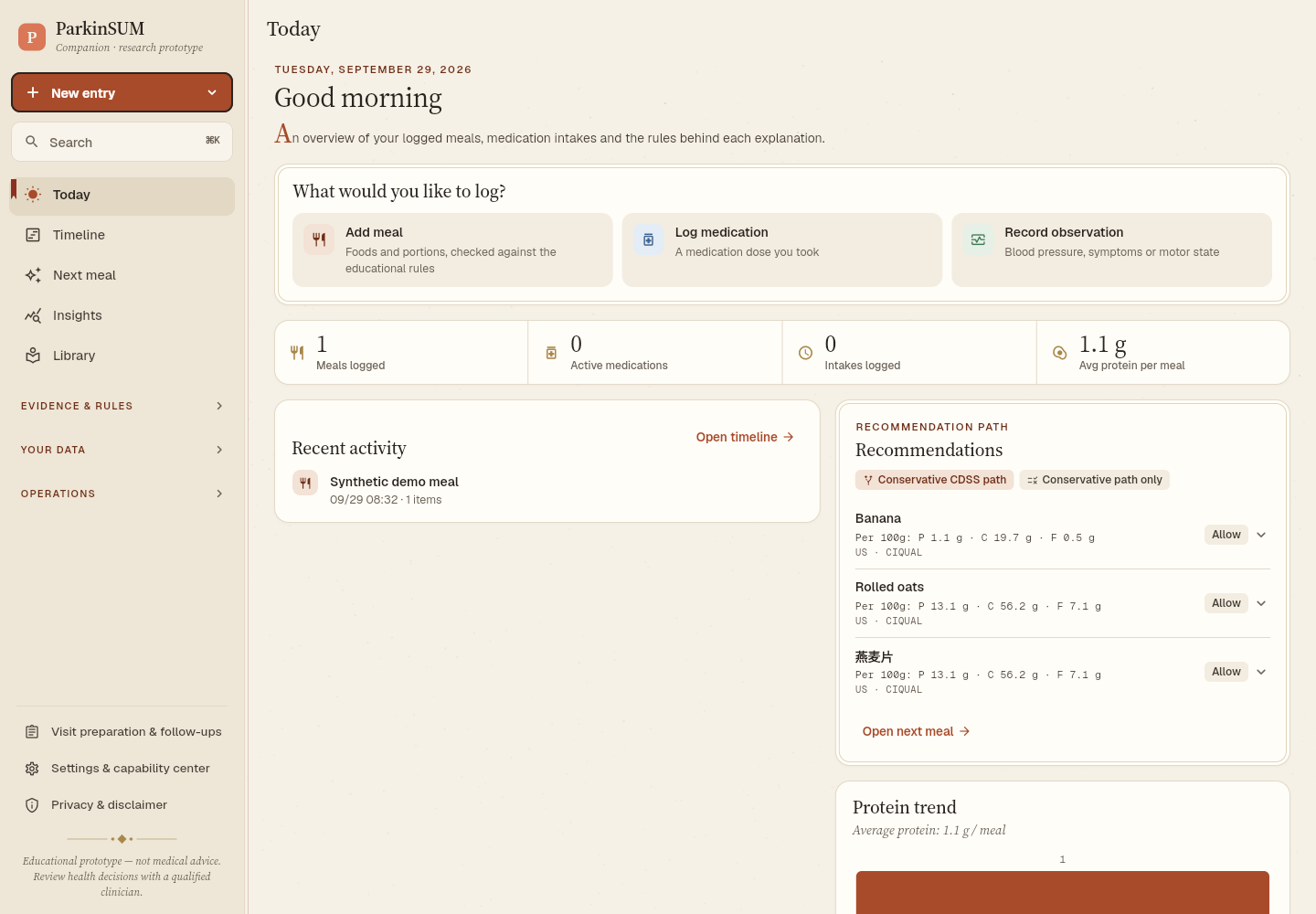
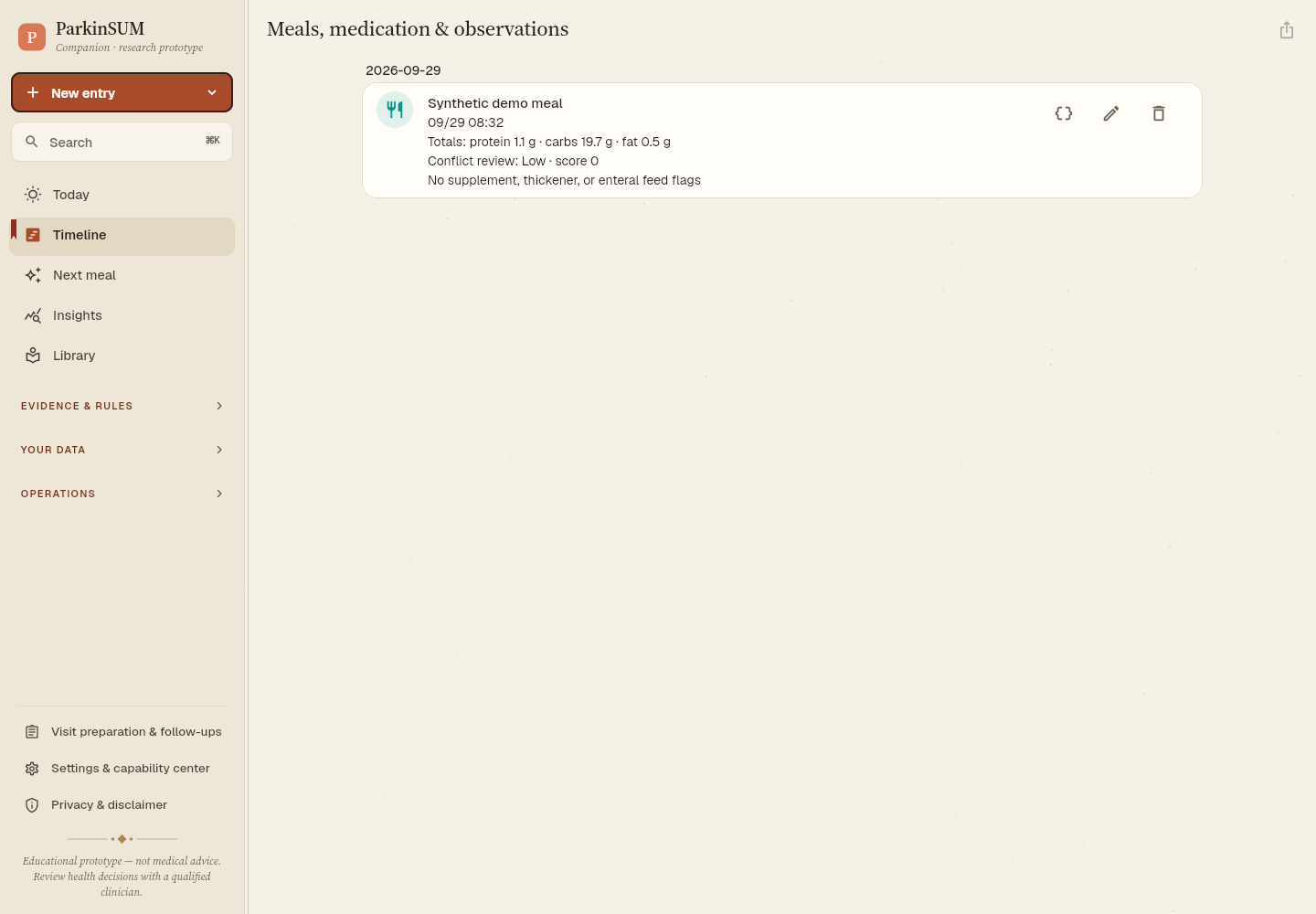
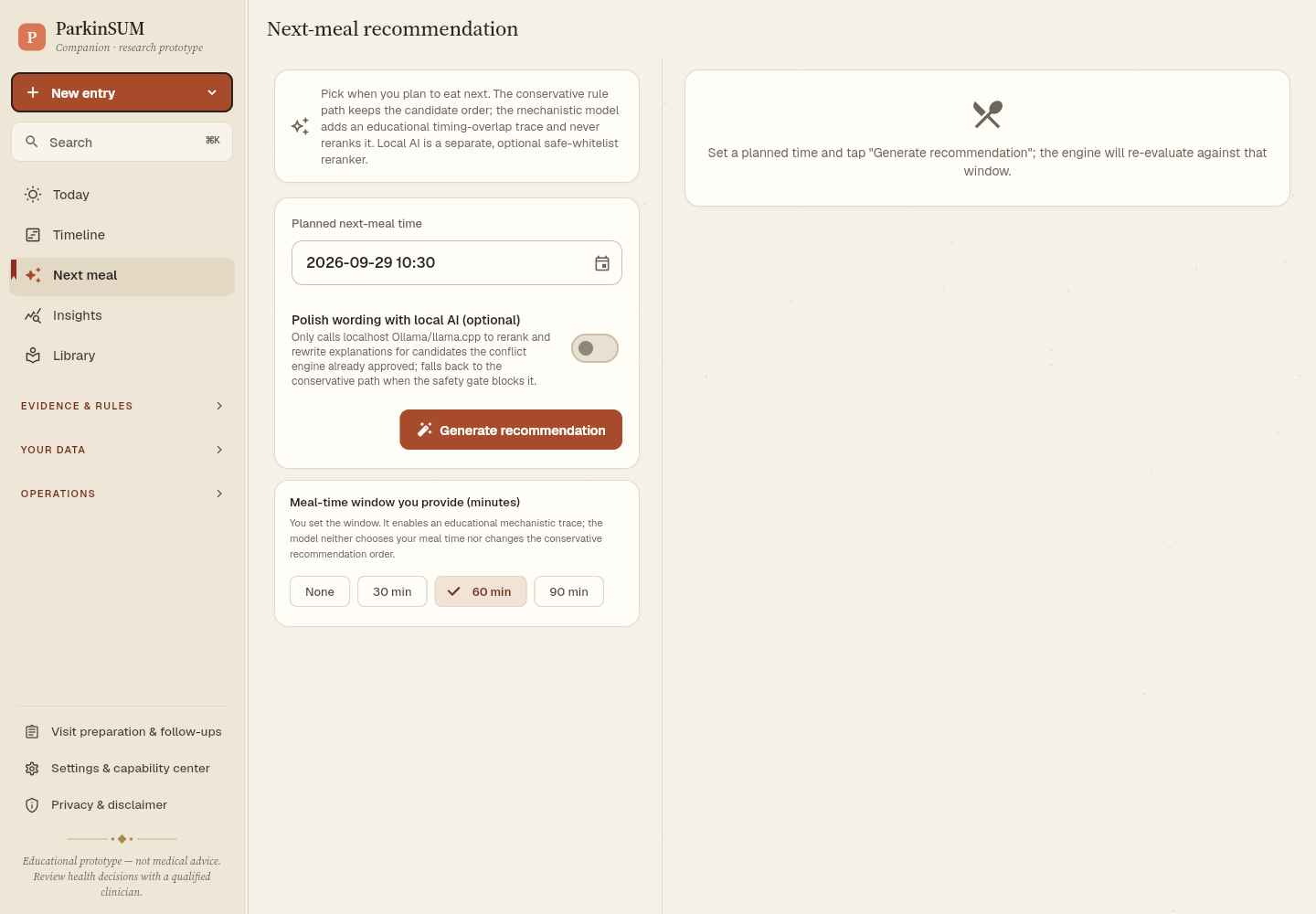
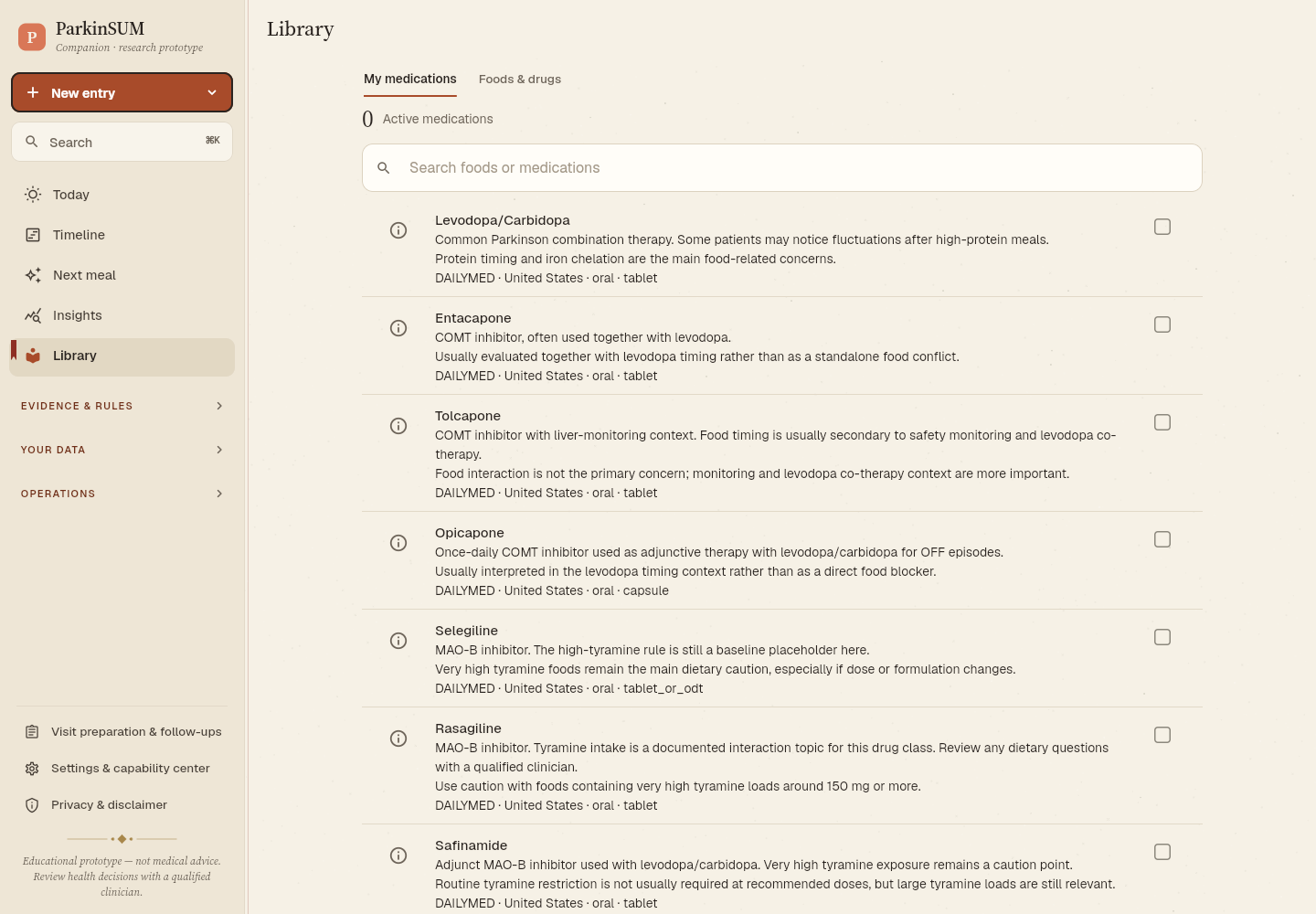
Actual local-mode browser captures, 29 September 2026, 1440 × 1000. Fresh synthetic profile; one banana meal, zero selected medications, no AI consent. Captured from the development worktree, not a final-commit binary attestation. Capture provenance & evidence limits ↗
II. The evidence workspace
Look beyond the result.
The Algorithm Observatory uses fixed, non-personal scenarios to make the model's behavior inspectable. Production-derived traces and static contracts are labeled separately.
Traces with their limits.
Inspect explanation trees, configuration identities, missingness, and bounded sensitivity. Registry coverage is distinct from executable trace coverage.
Read the design decision ↗A case you can replay.
Review synthetic rule cases, authored expectations, and content-bound replay capsules. A passing case establishes agreement only with its scoped assertions.
Open the workbench guide ↗Know what is implemented.
Separate runtime features, fixture tests, reports, and proposals. Development-only standards experiments do not establish general interoperability.
Inspect capabilities & limits ↗The mechanistic model remains trace-only.
Its educational curves do not choose a meal time or reorder recommendations. Optional consent-gated loopback AI may only rerank rule-screened, non-BLOCK candidates or polish existing wording; it cannot override rule-owned decisions, scores, evidence, or safety gates.
The evidence archive
Pull a source from the shelf.
Choose a record. The wave travels out from it, its neighbours settle, the other columns step back, and the card comes forward with what it supports and what it does not.
Reference dataset
USDA FoodData Central, release 2025-04-24
- Supports
- Official nutrient ids, units and conversion factors; 26,995 SR Legacy rows for 280 foods, each re-read from the source CSV in tests.
- Does not support
- Personal intake, tolerance or a food choice for any specific person.
- Source id
- src.usda.fdc.full_download.2025_04_24
Reference dataset
USDA SR Legacy, April 2018
- Supports
- Paired raw/cooked, whole/part and fresh/dried records for consistency checks between foods.
- Does not support
- Every food a person eats: values are sample averages that describe foods, not people.
- Source id
- src.usda.sr_legacy.2018
Consensus standard
FAO Food and Nutrition Paper 77
- Supports
- General energy factors used to reconcile reported energy with the macronutrients.
- Does not support
- Proof of an error: a residual only flags a record for review within a tolerance.
- Source id
- src.fao.food_energy.2003
Primary human study
Nutt et al. 1989, plasma LNAAs
- Supports
- Naming LNAA competition as a studied mechanism in the competition trace.
- Does not support
- A universal penalty or a predictor. On a normal diet most participants showed no important LNAA effect, and the trace keeps that negative finding.
- Source id
- src.nutt.lnaa.1989
Analytical study
Duan et al. 2021, faba bean L-dopa
- Supports
- Food-borne L-dopa shown as presence and variability context.
- Does not support
- A cooked-serving amount, an absorbed amount or any dose equivalent.
- Source id
- src.duan.faba_ldopa_thermal.2021
Primary human study
Hallberg et al. 1991, calcium and iron
- Supports
- A co-consumption context note: single-meal isotope studies of calcium and non-heme iron.
- Does not support
- Long-term iron status or an instruction about food or medicines.
- Source id
- src.hallberg.calcium_iron.1991
Every model assumption points to one of these records. A record states what it supports and what it does not.
III. The record · October 2026
Data you can trace.
Changes you can audit.
Food values are copied from official sources and tested back against them. Every change to the model's configuration appends a ledger record that stays blocked until evidence exists.
- 26,995
- official FoodData Central rows for 280 foods, each re-read from the source CSV in tests
- 148
- nutrients per record, from individual sugars to 33 fatty-acid chain lengths
- 25
- disagreements inside the source records, pinned in tests and never corrected
- 0.2667
- median competing-LNAA fraction of protein across 140 records (the old reference was 0.45)
A source-record disagreement on a value the conflict engine uses adds an uncertainty reason and caps confidence. It never changes a score. Values describe foods, not people.
Record 01 · 2026-08-18
Initial governed baseline
- Change
- The v52 release refresh adopted as the first governed configuration.
- Disposition
- Blocked pending evidence · no approval
Record 25 · v76
Browser restore performance
- Change
- Digest reuse only for the exact same canonical string; canonical bytes and calculations unchanged.
- Disposition
- Blocked pending evidence · no approval
Record 26 · v77
LNAA load calibration
- Change
- Competing-LNAA fraction of protein calibrated on official amino-acid rows: 0.45 → 0.2667.
- Disposition
- Blocked pending evidence · no approval
Record 27 · v78
Reference-record identities
- Change
- Every official nutrient mapped; source-record findings cap confidence only; LNAA trace detail.
- Disposition
- Blocked pending evidence · no approval
- Prior records
- All 26 earlier records stay byte-exact.
Matching hashes prove software identity only. No record claims scientific validation, review or clinical qualification.
IV. Follow the work
Choose your way in.
Interactive app
Run the local demo
Open the Flutter workspace with a fresh synthetic profile and the local backend.
Engineering reviewReproduce the checks
Find commands, prerequisites, expected results, and the meaning of each check.
Development recordRead the update
Follow the September source update separately from versioned release artifacts.
Guided tourOpen the project guide
Review the architecture, demo route, and boundaries in a compact visual wiki.
GitHub wikiRead the animated wiki
The conflict engine, food-data provenance, and the evidence and ledger archives, page by page.
Evolution timelineSee every iteration
Dated entries with changed files, verification results, boundaries, and rollback steps.
A boundary, not a footnote
For educational review.
ParkinSUM is not a medical device or clinical decision tool. Its model is not clinically calibrated. Do not use it for diagnosis, treatment, medication timing, dietary guidance, patient care, or emergencies.
Public demonstrations use synthetic or sample data. Owner-entered records and exports may contain sensitive information and must stay out of public media.